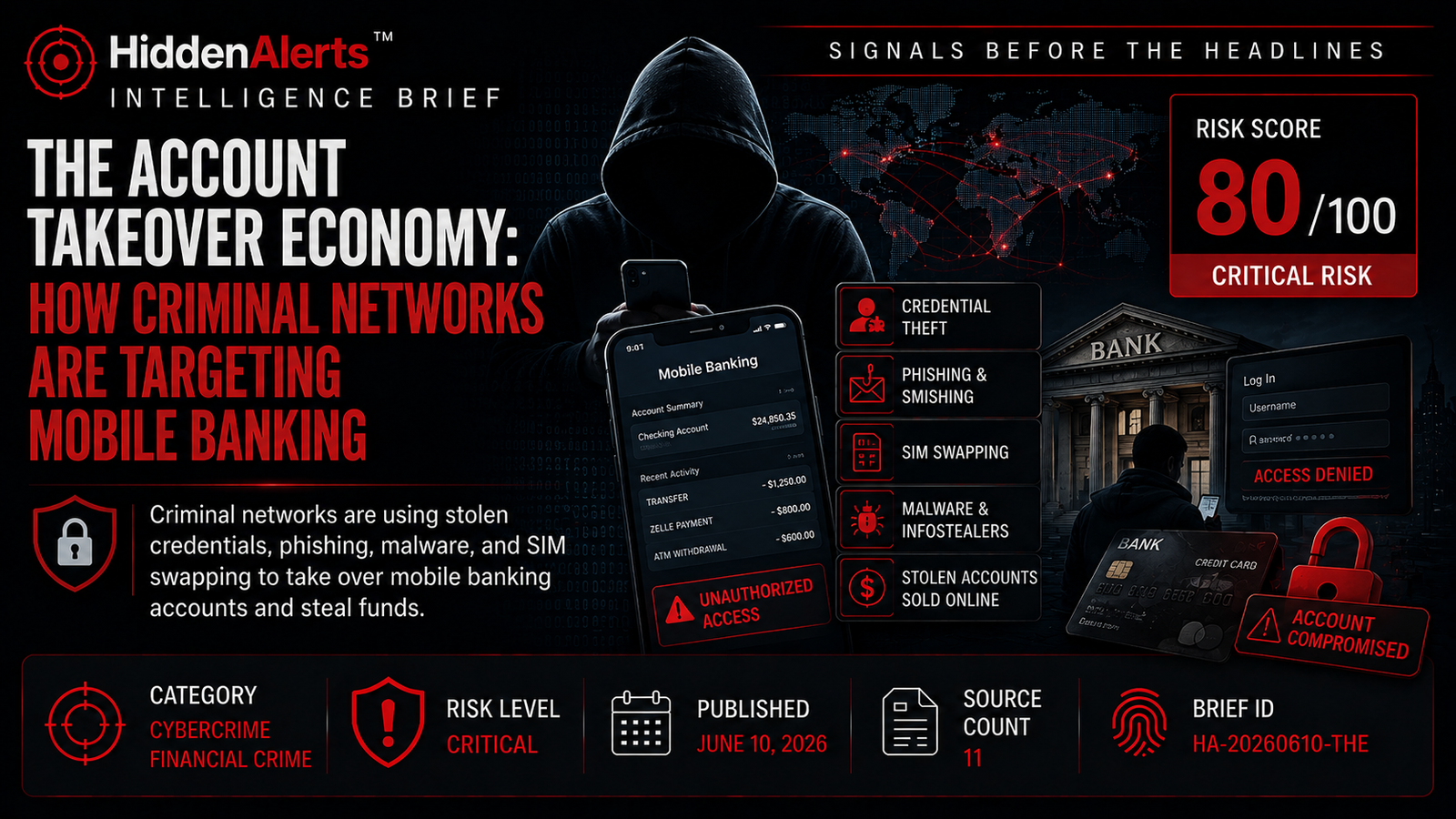
📅 Published: July 16, 2026 – Updated: July 17, 2026 – 8 min read.
EXECUTIVE SUMMARY
Account takeover attacks continue to increase as organized criminal groups industrialize credential theft and underground account marketplaces. Financial institutions face growing exposure from phishing, SIM swapping, malware, and credential resale operations. Organizations should strengthen authentication controls, monitor account behavior, and improve fraud detection capabilities.
Threat Assessment
This threat represents one of the fastest-growing sources of consumer banking fraud because attackers can purchase complete verified identities and authenticated sessions rather than stealing credentials individually.
INTELLIGENCE HIGHLIGHTS
Primary Threat
Credential Theft Markets
Primary Targets
Banks, Credit Unions
Fintech
Threat Actors
Organized Cybercrime Groups
Time Horizon
6 – 12 Months
Potential Impact
Credential Theft Markets
Analysis Confidence
High
Risk Score
80 / 100
Critical
Confidence
High
Analyst Reviewed
Region
United States
Multi-Country
Sources
11 Total
6 Government
5 Industry
Key Findings
- Mobile banking has become the preferred access channel for many consumers,
increasing exposure to account takeover activity. - Credential theft remains the primary enabler of mobile banking fraud.
- Criminal marketplaces increasingly provide complete account-access packages
rather than standalone credentials. - Fraud actors are combining phishing, malware, SIM swapping, and social
engineering to bypass authentication controls. - Account takeover activity is becoming increasingly industrialized and scalable
Business Impact
- Customer reimbursement costs
- Increased fraud losses
- Regulatory scrutiny
- Operational investigation costs
- Brand and reputation damage
- Increased customer churn
What Others Miss
- Most discussions surrounding account takeover focus on individual incidents, compromised passwords, or isolated fraud cases.
- The larger threat is the emergence of a highly organized fraud ecosystem supporting account takeover operations.
- Today, many fraud actors do not need to steal credentials themselves. Instead, they can purchase verified banking credentials, device fingerprints, session cookies, and customer information through underground marketplaces.
- This criminal supply chain enables account takeover operations to scale rapidly and lowers barriers to entry for less sophisticated actors.
- As a result, financial institutions are increasingly facing industrialized fraud operations rather than isolated attacks.
- The convergence of cybercrime and traditional financial fraud is accelerating.
- Many account takeover operations now resemble organized criminal enterprises with specialized roles, including credential theft, access brokerage, fraud execution, and money laundering.
Intelligence Analysis
Key Actors & Affiliations
Credential Brokers:
Threat actors specializing in acquiring and selling stolen banking credentials obtained through malware infections, phishing campaigns, and data breaches
Account Takeover Groups:
Criminal organizations that purchase stolen credentials and exploit compromised accounts for financial gain.
Phishing and Smishing Operators:
Fraud actors conducting email and text-message campaigns designed to capture banking credentials and authentication codes.
SIM Swapping Networks:
Criminal actors targeting mobile carriers to hijack customer phone numbers and intercept authentication messages.
Geograhic Focus
Primary Regions:
United States, Canada, United Kingdom, Australia
Western Europe, Secondary
Regions: Southeast Asia, Latin America, Eastern Europe
Why These Regions Matter:
United States:
High mobile banking adoption and a large concentration of financial institutions make the U.S. a primary target.
United Kingdom:
Strong digital banking usage and widespread mobile payment adoption create attractive opportunities for fraud actors.
Canada and Australia:
High rates of online and mobile banking usage continue to attract credential theft and account takeover activity.
Observations:
Account takeover campaigns are increasingly global, with threat actors operating across jurisdictions and targeting financial institutions regardless of geographic boundaries.
Risk Outlook
Threat Outlook
Expected Developments:
- Several developments are likely over the next 12-24 months.
- Continued growth in mobile banking-focused phishing and smishing campaigns.
- Increased use of AI-assisted social engineering techniques.
- Expansion of credential marketplace activity supporting account takeover operations.
- Greater use of malware designed specifically for mobile banking environments.
- Increased regulatory scrutiny regarding fraud prevention and customer protection
measures. - Continued convergence between cybercrime groups and traditional financial fraud networks.
- Financial institutions should expect account takeover activity targeting mobile banking platforms to remain a high-priority threat throughout the next several years
Recommended Actions
Immediate:
- Monitor account takeover indicators and anomalous login activity.
- Review authentication controls for mobile banking applications.
- Increase customer awareness regarding phishing and smishing attacks.
Short-Term:
- Evaluate fraud detection and behavioral analytics capabilities.
Assess account recovery procedures and identity verification processes.
Enhance monitoring of credential exposure and dark web activity.
Strategic:
- Implement phishing-resistant authentication methods where feasible.
- Expand device intelligence and behavioral monitoring.
- Strengthen fraud prevention collaboration with telecommunications providers regarding SIM swapping activity
Supporting Sources
🏦 Financial & International
HiddenAlerts Intelligence
Signals Before the Headlines
AI-Curated. Analyst-Reviewed. Intelligence You Can Act On.
© 2026 HiddenAlerts. All Rights Reserved.
For informational purposes only. HiddenAlerts Intelligence Briefs do not constitute legal, regulatory, or investment advice.